Last updated: November 2026. Human written and fact checked against each named source.
Ireland has always been a country of houses, but apartments are now a much bigger part of how it builds and how people live. A third of all new homes completed in 2025 were apartments, apartment planning permissions are up by two fifths on a year earlier, and more than half of rented homes are apartments. At the same time Ireland still has the lowest share of people living in flats in the European Union, tens of thousands of apartments built during the boom are affected by fire safety and water ingress defects, and every apartment block relies on an owners’ management company and its sinking fund to keep common areas in repair. This page brings together the current figures on apartments in Ireland: how many there are, where they are, how old they are, how many are being built, what they cost, how energy efficient they are and how they are maintained. Every number links to the source it came from.
Key Apartment Statistics for Ireland at a Glance
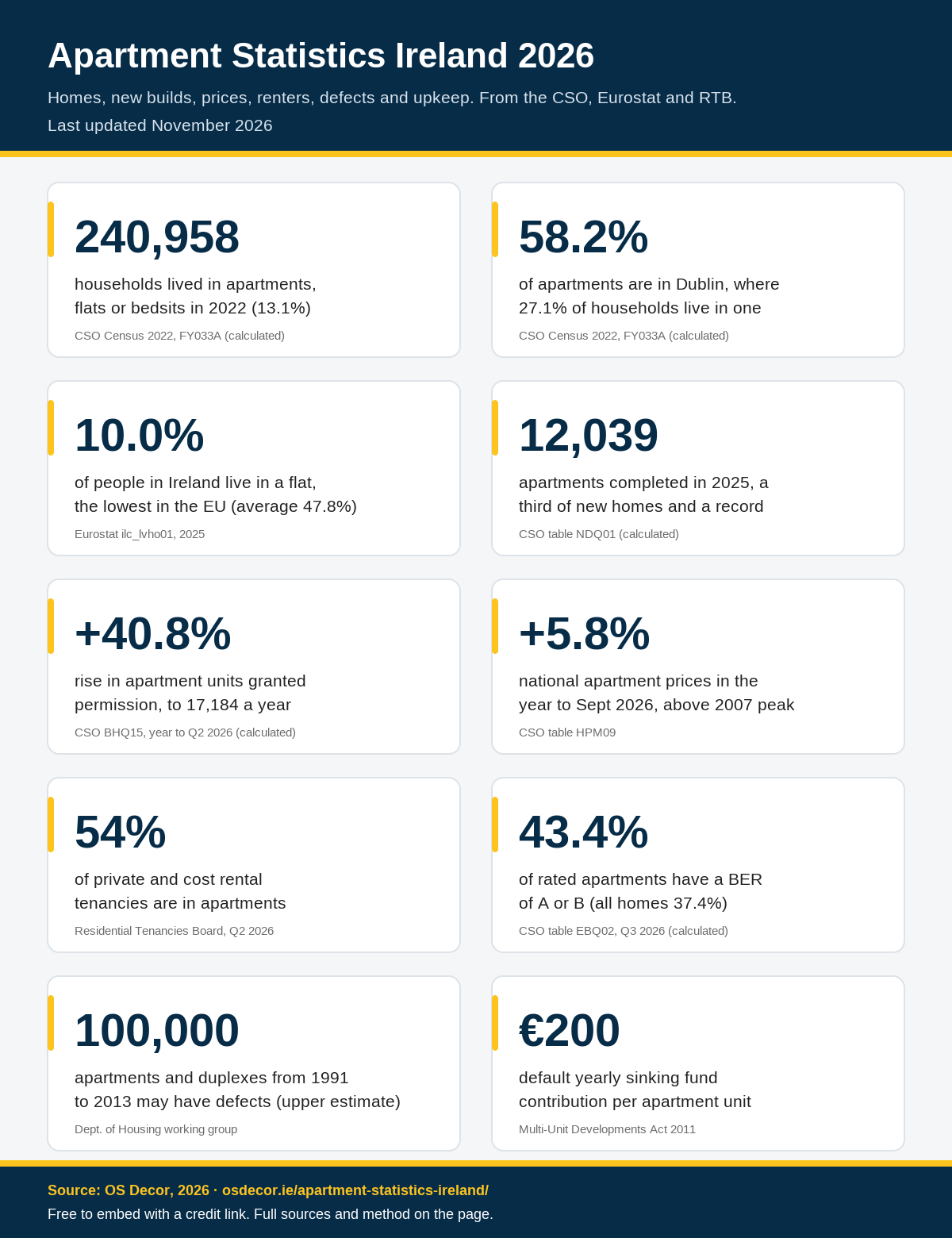
- 240,958 households lived in apartments, flats or bedsits in 2022, 13.1% of all households in permanent housing (calculated). Source: CSO Census 2022, table FY033A
- 58.2% of those apartments are in Dublin, where 27.1% of households live in an apartment, rising to 38.5% in the Dublin City Council area (calculated). Source: CSO Census 2022, table FY033A
- Only 10.0% of people in Ireland lived in a flat in 2025, the lowest share in the European Union, against an EU average of 47.8%. Source: Eurostat, table ilc_lvho01
- 12,039 apartments were completed in 2025, 33.2% of all new homes and the highest number in the CSO series, which starts in 2011 (calculated). Source: CSO New Dwelling Completions, table NDQ01
- 8,475 apartments were completed in the first nine months of 2026, 6.6% more than in the same period of 2025 (calculated). Source: CSO table NDQ01
- 17,184 apartment units were granted planning permission in the year to the second quarter of 2026, up 40.8% on the previous year (calculated). Source: CSO Planning Permissions, table BHQ15
- National apartment prices rose 5.8% in the year to September 2026 and are now 7.8% above their 2007 peak, while Dublin apartment prices are still 0.8% below theirs (calculated). Source: CSO Residential Property Price Index, table HPM09
- 54% of private and cost rental tenancies registered with the Residential Tenancies Board in mid 2026 were in apartments. Source: Residential Tenancies Board, September 2026
- Between 62,500 and 100,000 apartments and duplexes built between 1991 and 2013 may be affected by fire safety, structural or water ingress defects, with a total repair cost estimated at €1.56 billion to €2.5 billion. Source: Department of Housing, Working Group to Examine Defects in Housing
- The default sinking fund contribution for an apartment is €200 a year per unit unless the members of the owners’ management company agree a different amount. Source: Multi-Unit Developments Act 2011, section 19
How Many Apartments Ireland Has
Census 2022 counted 1,836,728 households in permanent housing, and 240,958 of them, 13.1%, lived in an apartment, flat or bedsit (calculated from CSO table FY033A). Most of these, 190,197 or 78.9%, were in purpose-built apartment blocks. A further 49,102, 20.4%, were flats in converted houses or commercial buildings, and 1,659 were bedsits (calculated).
Apartments are concentrated in Dublin. The four Dublin local authorities had 140,275 apartment households in 2022, 58.2% of the national total and 27.1% of all Dublin households (calculated). The share varies widely within the county: 38.5% of households in the Dublin City Council area lived in an apartment, compared with 24.7% in Dún Laoghaire-Rathdown, 17.3% in Fingal and 13.9% in South Dublin (calculated).
Ireland Compared with Europe
Even with the recent growth, very few people in Ireland live in apartments by European standards. In 2025, 10.0% of the population lived in a flat, the lowest share of all 27 EU countries, compared with an EU average of 47.8% (Eurostat, ilc_lvho01). The next lowest was the Netherlands at 21.8%, and in Spain, Latvia and Malta more than 64% of people live in flats. Ireland’s share has hardly changed in recent years: it was 10.2% in 2022 and 2023 and 9.7% in 2024.
How Old Ireland’s Apartments Are
Ireland’s purpose-built apartment stock is young. Of the 190,197 households in purpose-built apartments in 2022, 116,060, or 61.0%, were in buildings completed in 2001 or later, and 92,492, or 48.6%, were in buildings completed between 2001 and 2010 alone (calculated from CSO table FY033A). Two thirds of purpose-built apartments, 66.6%, were built between 1991 and 2010 (calculated). That matters because buildings of that age are now reaching the point where common areas, stairwells and external finishes need their first or second major refurbishment, and because many of them were built during the period covered by the Government’s defects review.
New Apartments: Completions and Planning Permissions
Apartment building has grown rapidly. In 2025, 12,039 apartments were completed, 33.2% of the 36,215 new homes completed that year and three and a half times the 3,418 completed in 2019 (calculated from CSO table NDQ01). That was the highest annual number of apartment completions in the series, which starts in 2011. Completions have continued to rise in 2026: 8,475 apartments were completed in the first three quarters, 6.6% more than in the same period of 2025, including 3,464 in the third quarter alone (calculated).
| Year | Apartments completed | All new homes completed | Apartment share (calculated) |
|---|---|---|---|
| 2019 | 3,418 | 21,013 | 16.3% |
| 2022 | 9,021 | 29,609 | 30.5% |
| 2023 | 11,522 | 32,463 | 35.5% |
| 2024 | 8,685 | 30,124 | 28.8% |
| 2025 | 12,039 | 36,215 | 33.2% |
Source: CSO New Dwelling Completions, table NDQ01 (sum of the four quarters of each year). Shares are calculated.
The planning pipeline points to more to come. 17,184 apartment units were granted planning permission in the four quarters to the second quarter of 2026, up 40.8% from 12,205 in the previous four quarters (calculated from CSO table BHQ15). Apartments made up 43.7% of all residential units granted permission over that period, alongside 22,170 house units (calculated). In calendar year 2025, 14,359 apartment units were permitted, up from 13,194 in 2024.
Apartment Prices
Apartment prices are rising faster than house prices. In the year to September 2026, the CSO’s Residential Property Price Index for apartments rose 5.8% nationally, compared with 4.6% for houses (CSO table HPM09). Outside Dublin, apartment prices rose 7.6%, while Dublin apartment prices rose 5.0%. The national apartment index is now 7.8% above its February 2007 peak, but in Dublin apartment prices are still 0.8% below their 2007 high (calculated).
Social landlords are building more of the new rented stock: approved housing bodies delivered 4,211 new-build social homes in 2025, 46% of the total (calculated), as our social housing statistics for Ireland show.
Renting Apartments
Apartments are central to the rental market. At the end of the second quarter of 2026, 54% of the private and cost rental tenancies registered with the Residential Tenancies Board were in apartments, and 46% were in houses (RTB, Director’s Quarterly Update, September 2026). Among tenancies provided by Approved Housing Bodies, 51.8% were in apartments. There were 247,258 registered private and cost rental tenancies in total, so apartments account for more than 130,000 rented homes (calculated). A change of tenant is a natural point to redecorate.
Energy Ratings of Apartments
Apartments are the most energy efficient type of home in Ireland on average. Of the 279,658 apartments with a Building Energy Rating at the end of the third quarter of 2026, 43.4% were rated A or B, compared with 37.4% of all rated homes, and only 13.7% were rated E, F or G, compared with 16.4% of all homes (calculated from CSO table EBQ02). By comparison, 36.1% of rated detached houses, 36.3% of semi-detached houses and 34.1% of mid-terrace houses reached A or B (calculated). Shared walls and floors mean apartments lose less heat than detached and semi-detached houses, and as shown above most were built after 2000.
Defects in Boom-Era Apartments
The biggest maintenance issue facing Irish apartments is the legacy of defects in buildings from the boom years. A Government working group estimated that between 50% and 80% of apartments and duplexes built between 1991 and 2013, or their common areas, may be affected by one or more defects, equivalent to between 62,500 and 100,000 homes (Department of Housing, July 2022). Fire safety defects are the most common, potentially affecting 40% to 70% of these properties, followed by water ingress at 20% to 50% and structural safety at 5% to 25%.
The working group put the average cost of remediation at about €25,000 per apartment or duplex, giving a total of roughly €1.56 billion to €2.5 billion. It found that remedial works may already have been completed on up to 12% of affected properties and may be under way on up to 34%. Water ingress in particular leaves damaged plaster, stained ceilings and failed external finishes, so redecoration usually follows once the underlying defect has been fixed.
Management Companies and Sinking Funds
Apartment developments with shared common areas are run by an owners’ management company, which is owned by the apartment owners themselves. Under the Multi-Unit Developments Act 2011, each owners’ management company must keep a sinking fund for refurbishment, improvement and non-recurring maintenance of the development, and each unit owner must contribute to it (Multi-Unit Developments Act 2011, section 19). The default contribution is €200 a year per unit, unless a meeting of members agrees a different amount. Repainting stairwells, corridors, lobbies and external walls is a typical non-recurring cost paid from the sinking fund, which is why management companies usually plan large decorating jobs years in advance and approve them at a general meeting.
What This Means for Painting and Decorating
Three things stand out. First, the apartment stock is concentrated and growing: almost three in five apartments are in Dublin, a third of new homes are apartments, and permissions are up by 40.8%, so apartment interiors and common areas are a growing share of decorating work. Second, the stock built between 1991 and 2010 is now old enough to need major refurbishment, and much of it has defects to fix first, especially water ingress, which leaves walls and ceilings needing to be made good and repainted. Third, more than half of rented homes are apartments, and each change of tenant is a chance to redecorate. For the wider picture, see our housing stock statistics, property market statistics and damp and mould statistics.
Method and Sources
All figures on this page were checked at source in November 2026. Apartment households, Dublin shares and the age of purpose-built apartments are from CSO table FY033A (Census 2022), where apartments are purpose-built flats, flats in converted houses or commercial buildings, and bedsits. The share of people living in flats is from Eurostat table ilc_lvho01 (2025), and the EU ranking was calculated from the same table. Completions are from CSO table NDQ01 (to the third quarter of 2026), planning permissions from CSO table BHQ15 (to the second quarter of 2026, apartment units in strategic and non-strategic housing developments combined), prices from CSO table HPM09 (September 2026, published 18 November 2026), and energy ratings from CSO table EBQ02 (homes with a BER at the end of the third quarter of 2026). Rented apartments are from the Residential Tenancies Board’s Director’s Quarterly Update of September 2026, and the figure of more than 130,000 is calculated from its 54% share. Defect estimates are from the report of the Working Group to Examine Defects in Housing, published by the Department of Housing on 28 July 2022, and sinking fund rules from section 19 of the Multi-Unit Developments Act 2011. Where a share, change or ranking is described as calculated, it was derived from the named source and the working is available on request. The page will be refreshed with each quarterly CSO completions and permissions release.
How OS Decor Helps
OS Decor paints apartments across Dublin, Kildare, Meath and Wicklow for homeowners, landlords and property investors, from a single room to a full apartment between tenancies. Our apartment painting Dublin service covers walls, ceilings and woodwork with careful preparation, our commercial painting team can quote for larger buildings, and you can contact us for a free quote.
